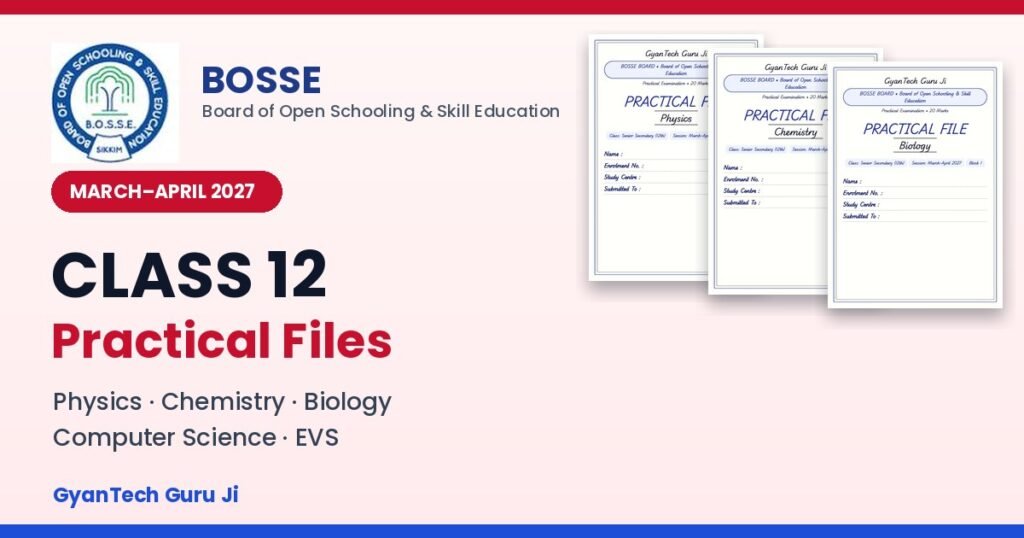
Solved practical files for BOSSE Class 12 (Senior Secondary) science and technology subjects, for the BOSSE Board practical examination, session March–April 2027 (Block 1).
Class 12 Physics Practical File
10 practicals · 38 pages · PDF.
- To determine the diameter of a given wire using a screw gauge.
- To determine the specific heat of a solid using the method of mixtures.
- To determine the internal resistance of a primary cell using a potentiometer.
- To compare the frequencies of two tuning forks by finding first and second resonance positions in a resonance tube.
- To find the value of v for different values of u in case of a concave mirror and to find its focal length (f) by plotting a graph between 1/u and 1/v.
- To draw a graph between the angle of incidence (i) and angle of deviation (D) for a glass prism and to determine the refractive index of the glass of the prism using this graph.
- To verify the law of combination (series and parallel) of resistances using the ammeter–voltmeter method and coils of known resistances.
- To draw the characteristic curve of a forward biased pn junction diode and to determine the static and dynamic resistance of the diode.
- To draw the characteristics of an npn transistor in common emitter mode. From the characteristics, find out (i) the current gain (β) of the transistor and (ii) the voltage gain A_V with a load resistance of 1 kΩ.
- To draw the lines of force due to a bar magnet kept (i) with its N-pole pointing north and (ii) with its N-pole pointing south, and to locate the neutral points.
Class 12 Chemistry Practical File
10 practicals · 38 pages · PDF.
- To study simple reactions of carbohydrates, fats and proteins and the detection of their presence in given foodstuffs.
- To detect the presence of extra elements (nitrogen, sulphur and halogens) in an organic compound.
- To separate the coloured components of (a) black ink or a mixture of red and blue inks and (b) juice of a flower or grass by paper chromatography, and to compare their Rf values.
- Surface Chemistry: Preparation of lyophilic and lyophobic sol. (Lyophilic sol – starch; Lyophobic sol – ferric hydroxide)
- Electrochemistry: To study the variation of cell potential in Zn/Zn²⁺ || Cu²⁺/Cu with change in concentration of electrolytes (CuSO₄ or ZnSO₄) at room temperature.
- Thermochemistry (any one): (i) To determine the enthalpy of solution of potassium nitrate (copper sulphate); (ii) To determine the enthalpy of neutralisation of a strong acid (HCl) with a strong base (NaOH).
- Preparation of Inorganic Compounds: Preparation of double salt of ferrous ammonium sulphate (Mohr’s salt).
- Chromatography: (i) Separation of coloured substances by paper chromatography and comparison of their Rf values for a mixture of red and blue ink; OR (ii) separation of coloured substances by paper chromatography and comparison of their Rf values for juice of a flower or grass.
- Volumetric Analysis (Quantitative analysis): (i) Preparation of standard solutions of oxalic acid and ferrous ammonium sulphate; (ii) acid–base titration (NaOH against oxalic acid); (iii) redox titration (KMnO₄ against Mohr’s salt).
- Tests for the functional groups present in organic compounds: unsaturation; carboxylic, phenolic, aldehydic and ketonic groups.
Class 12 Biology Practical File
10 practicals · 34 pages · PDF.
- To study the morphological modifications of plant parts like root, stem and leaf.
- To study the physical properties of different soil samples.
- To demonstrate the release of CO₂ during germination of seeds.
- To study the physical properties of different soil samples (percolation rate and water holding capacity).
- To demonstrate osmosis by using a potato osmometer.
- To study the T.S. of dicot and monocot stems and roots from permanent slides.
- To study the structure and function of different parts of flowers (Petunia and China rose).
- Study of animal specimens’ classification: To identify the characteristic features of sponge, earthworm, butterfly, apple snail, starfish, cartilaginous fish (dogfish, Scoliodon), bony fish (rohu) and toad.
- Study the structure and germination in gram and bean seeds.
- To make a herbarium.
Class 12 Digital Literacy & Computer Science Practical File
10 practicals · 32 pages · PDF.
- To write a C++ program that accepts radius and then displays the area and perimeter of a circle. Consider “Pi” as a constant with value 3.14.
- To write a C++ program to accept a character. Print whether the character is an alphabet, digit or a special character. Display appropriate messages.
- Gita is running a departmental store in her colony. She wants to computerise the billing system. Consider a class containing suitable members and associated functions. The program should store details of all the bills in the file “BILL.dat”. Also a discount of 10% on the net bill amount should be given to all the customers whose net bill amount exceeds Rs 2000.
- Write a C++ program (using while loop) to display all the multiples of 5 from 100 to 50.
- Create a learner table using SQL commands in the following format.
- Add a new column in the existing table using SQL command.
- Perform DML commands UPDATE and DELETE on the following table.
- Create an HTML document which will display the ordered list of practicals mentioned in this manual.
- Create an HTML document which will display the ordered list of practicals mentioned in this manual (with list types and nested lists).
- Create a web page that contains the following table.
Class 12 Environmental Science & Sustainable Development Practical File
10 practicals · 30 pages · PDF.
- Sources of pollution in water from different sources.
- To study the texture of soil samples.
- (a) To study the climate of an urban area. (b) To study the yearly variation in suspended particulate matter (SPM) in an urban area.
- To study the quality of a water sample.
- To segregate domestic waste into bio-degradable and non-biodegradable waste.
- To prepare a herbarium sheet.
- To set up an aquarium.
- To study the biodiversity of birds and insects in the locality.
- To list the plants and animals used for making meals at home on one day, and write their habit and habitat.
- To audit the electrical energy consumption of household appliances.
How to download
- Tap Sample under your subject and check the cover, index, first practical and a diagram page.
- Tap Download Now and pay securely (UPI / card / net banking).
- Your PDF downloads instantly.
These are study-help practical files, not an official BOSSE publication. Always follow the instructions of your study centre and copy the file in your own handwriting.