यह गाइड हिंदी में पढ़ें: सिलेबस: 6 कोर्स, 55 अध्याय
The Bridge Course has six theory and pedagogy courses plus School Experience. The curriculum is given in Annexure 1 of the official Programme Guide. Below is the full chapter-wise structure so that you know what to study before the contact classes and the term-end exam. Study material is provided digitally (e-SLM) on the Bridge Course portal.
Course 1 – Child Development and Educational Psychology (4 credits)
Aim: a systematic introduction to the study of childhood and child development so that teachers understand the children they teach. 4 units, 9 chapters.
| Unit | Chapters |
|---|---|
| Unit 1 – Childhood | 1. Understanding Childhood · 2. Childhood and Socialization |
| Unit 2 – Child development | 3. The Indian Concept of Self · 4. Development · 5. Play and Development |
| Unit 3 – Process of learning | 6. Concept Formation · 7. Learning Theories |
| Unit 4 – Inclusive learning | 8. Learning by Children with Special Needs · 9. Learner Friendly Environment |
Topics include constructs of childhood in the Indian context, differences in socialisation, parenting and child-rearing practices, child labour, play and development, learning theories, learning disabilities and children with special needs (Divyang), and creating an inclusive, learner-friendly environment.
Course 2 – Curriculum, Pedagogy and Assessment (4 credits)
Aim: to help teachers see how what is taught (curriculum), how it is taught (pedagogy) and how learning is assessed are connected. 4 units, 9 chapters.
| Unit | Chapters |
|---|---|
| Unit 1 – Curriculum | 1. Curriculum · 2. Curricular Issues and Concerns |
| Unit 2 – Learning environment and resources | 3. Designing Creative and Child-Friendly Learning Environment · 4. Learning Resources · 5. Role of Teachers in Operationalizing and Evaluating Curriculum |
| Unit 3 – Teaching approaches | 6. Techniques for Effective Teaching at Foundational and Preparatory Stage · 7. Learning through Play |
| Unit 4 – Assessment | 8. Assessment · 9. Tools and Techniques of Assessment (360° progress reports, portfolios, PARAKH, qualitative reporting) |
Course 3 – Pedagogy of Language-I: Hindi / Regional Language (2 credits)
Aim: to make primary teachers familiar with basic and new ideas of language education at the foundational and preparatory stage, with clear understanding of learning outcomes, so that they can organise suitable language activities. The course is written in Hindi. 3 units, 11 chapters.
| Unit | Lessons (Hindi titles translated) |
|---|---|
| Unit I – Understanding language education and multilingualism | 1. Language education: policies (NEP 2020, NCF-FS 2022, NCF-SE 2023) and multilingualism · 2. Emergent literacy and the language curriculum |
| Unit II – Pedagogy and resources | 3. Four-block model and oral language development · 4. Word recognition strategies · 5. Reading and various resources (reading corner, children’s literature, Jaadui Pitara, DIKSHA, SWAYAM) · 6. Developing writing skills |
| Unit III – Planning and assessment | 7. Unit plan and lesson plan · 8. Assessment of oral language · 9. Assessment of reading · 10. Assessment of writing · the final lesson completes the unit |
Course 4 – Pedagogy of Language-II: English (2 credits)
Aim: to help teachers organise classroom activities with an understanding of language curriculum goals, competencies and learning outcomes, and to plan a Language-II class, including the transition from mother tongue to another language and multilingualism. 3 units, 11 chapters.
| Unit | Chapters |
|---|---|
| Unit 1 – Understanding language education | 1. Language Education: various policies and multilingualism · 2. Second Language Acquisition and Curricular goals |
| Unit 2 – Pedagogy of language | 3. Four Block Approach and Oral Language Development · 4. Word Recognition: various strategies · 5. Reading and various resources · 6. Writing and Development of writing skill |
| Unit 3 – Planning and assessment | 7. Development of Unit plans and Chapter plans · 8. Assessment of Oral Language · 9. Assessment of Reading · 10. Assessment of Writing · 11. Other dimensions of assessment |
Course 5 – Pedagogy of Mathematics (2 credits)
Aim: deeper insight into mathematics education so that the mathematics classroom becomes lively and joyful for primary children. 3 units, 7 chapters.
| Unit | Chapters |
|---|---|
| Unit 1 – Introduction to mathematics | 1. Nature of Mathematics · 2. How children learn Mathematics (numeracy, foundational numeracy, pre-number concepts) · 3. Mathematical communication |
| Unit 2 – Pedagogy and resources | 4. Teaching learning in Mathematics · 5. Resources in Mathematics Learning |
| Unit 3 – Planning and assessment | 6. Planning in Mathematics · 7. Assessment in Mathematics (continuous and school-based assessment) |
Course 6 – Pedagogy of The World Around Us (2 credits)
Aim: to understand the nature, scope and importance of ‘The World Around Us’ as a composite discipline with Science, Social Sciences and Environmental Education. 3 units, 8 chapters.
| Unit | Chapters |
|---|---|
| Unit 1 – Nature and scope | 1. Nature and Scope of The World Around Us (interdisciplinary and integrated nature) · 2. Children’s Ideas and Alternate Conceptions |
| Unit 2 – Pedagogy and resources | 3. Teaching learning in The World Around Us · 4. Process skills · 5. Resources · 6. Textbooks |
| Unit 3 – Planning and assessment | 7. Planning · 8. Assessment |


Course 7 – School Experience (practicum)
Course 7 is not a theory paper. It is assessed through 40 lesson plans, a portfolio, activity and workshop records and a reflective journal – covered in detail in our separate article on School Experience.
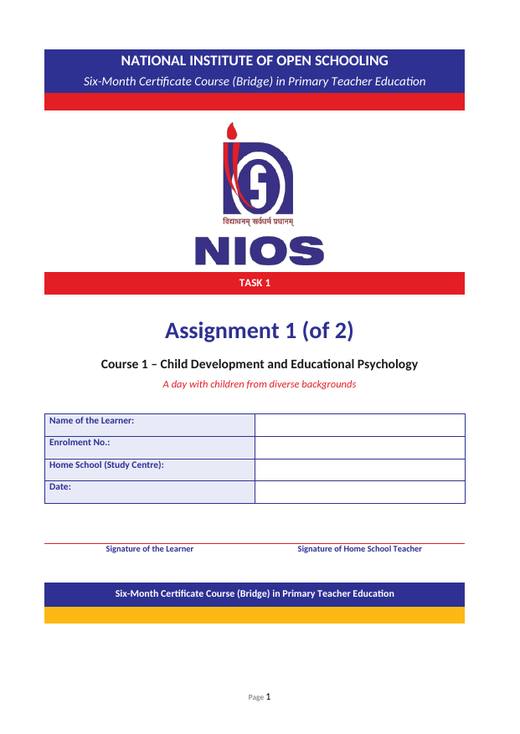

Online contact classes: how the syllabus is taught
The Bridge Course has a 10-day online contact programme of 40 sessions of 90 minutes each (60 contact hours). Sessions are held on weekends or holidays and focus on solving the specific difficulties you meet during self-study.
| Course | Sessions (90 min) | Contact hours |
|---|---|---|
| 1 | 8 | 12 |
| 2 | 8 | 12 |
| 3 | 4 | 6 |
| 4 | 4 | 6 |
| 5 | 4 | 6 |
| 6 | 4 | 6 |
| 7 – School Experience | 8 | 12 |
| Total | 40 | 60 |
How to study this syllabus
- Download the Programme Guide and read Annexure 1 once, so you know every unit.
- Study the e-SLM chapter by chapter from your dashboard and watch the NIOS video tutorials.
- Note your doubts and ask them in the live contact classes.
- Link each chapter to your own classroom; this makes your assignments and reflective journal stronger.
- Revise with the question types of the term-end exam (3-hour papers for Courses 1 and 2, 1-hour papers for Courses 3 to 6).
One payment · one click · instant download. This is reference material.
Guide books and official reference documents mentioned in the Programme Guide
The Programme Guide itself points teachers to the following official documents and platforms. Keep them at hand while studying and while preparing your assignments:
| Resource | What it is used for |
|---|---|
| NIOS Programme Guide (Bridge Course) | Rules, fee, credits, assessment scheme, passing criteria, curriculum (Annexure 1), school experience (Annexure 2), contact-class schedule (Annexure 3) and the official task list (Annexure 4). |
| NEP 2020 (National Education Policy 2020) | Course 2 – Task 1 asks for a critical analysis; also the policy base for Language-I and Language-II. |
| NCF-FS 2022 (National Curriculum Framework for Foundational Stage) | Curricular goals, competencies and pedagogy for the foundational stage; used in Courses 2, 3, 4, 5 and 6. |
| NCF-SE 2023 (National Curriculum Framework for School Education) | School-education framework; used for the curricular and pedagogic recommendation reports in Courses 4, 5 and 6. |
| NCERT / state-board textbooks (including Our Wondrous World for The World Around Us) | Textbook-analysis tasks in Courses 3, 4, 5 and 6. |
| NIOS e-Self Learning Material (e-SLM) | Digital study material for all six theory courses, provided in digital format. Programme Guide link: nios.ac.in/online-course-material.aspx and the new Bridge Course website. |
| NIOS YouTube channel and live video programmes | Video tutorials and live sessions that support the self-learning material. |
| Jaadui Pitara / e-Jaadui Pitara | Play-based learning material; used in Courses 4, 5 and 6 tasks and in the school-experience activities. |
| DIKSHA portal and SWAYAM portal | Video-analysis tasks (Courses 4, 5, 6) and digital reading resources for Language-I. |
| PARAKH assessment / report cards | Course 2 Task 7 and Course 6 Section B Task 3 – filling sample report cards and building worksheets as per PARAKH guidelines. |
English medium and Hindi medium · every file in PDF and editable Word · one payment, one click, instant download.
Frequently asked questions
Which language is the syllabus in?
The medium of instruction is Hindi and English. Course 3 (Language-I) is written in Hindi, and you may write the theory exam in any of the 22 scheduled languages.
How many chapters are there in total?
Annexure 3 of the Programme Guide lists 55 chapters across Courses 1 to 6.
Is there a separate syllabus for School Experience?
Yes. Annexure 2 describes the practicum: 40 lessons, portfolio, activities and workshop record, and reflective journal.
- Official Bridge Course portal (registration, dashboard, notices): https://bridge.nios.ac.in/
- Official Programme Guide (PDF): Programme-Guide-Teachers.pdf
- Ready PDF + Word practicum pack, editable (assignments, lesson plans, diary, portfolios, activities): https://gyantechguruji.com/nios-bridge-course-pdf-word/
- 100% handwritten PDF sets (12 assignments, 40 lesson plans, diary, portfolio, activities; Hindi, English and more languages): https://gyantechguruji.com/nios-bridge-course-2026/
- Handwritten Complete Combo Pack (7 files in one payment): https://gyantechguruji.com/bridge.nios.ac.in/